Health Measures
Comparing community costs with observed member outcomes
Build a full community cost ledger, count confirmed member outcomes and distinguish operating cost from spending a change would actually avoid.
Compare the full cost of running a community with member outcomes the team can observe or confirm. Keep the cost ledger, outcome counts and any proposed monetary benefit calculation separate. This supports a spending decision without treating every visit or reply as a claimed saving.
Cost the work the community requires
Choose a review period and list the resources used during it. Include platform and integration charges, staff time answering and moderating, specialist reviews, content maintenance, events, access administration and relevant management work. Record volunteer support as a dependency even when it has no invoice. Mark each cost as ongoing, one-off or shared with another service.
Use a consistent allocation rule for shared work. For example, sample the time staff spend on community cases and apply an agreed staff-cost method. Do not assign all support-team costs to the community because the team sometimes answers there. Keep the method with the ledger so a reviewer can reproduce or challenge it.
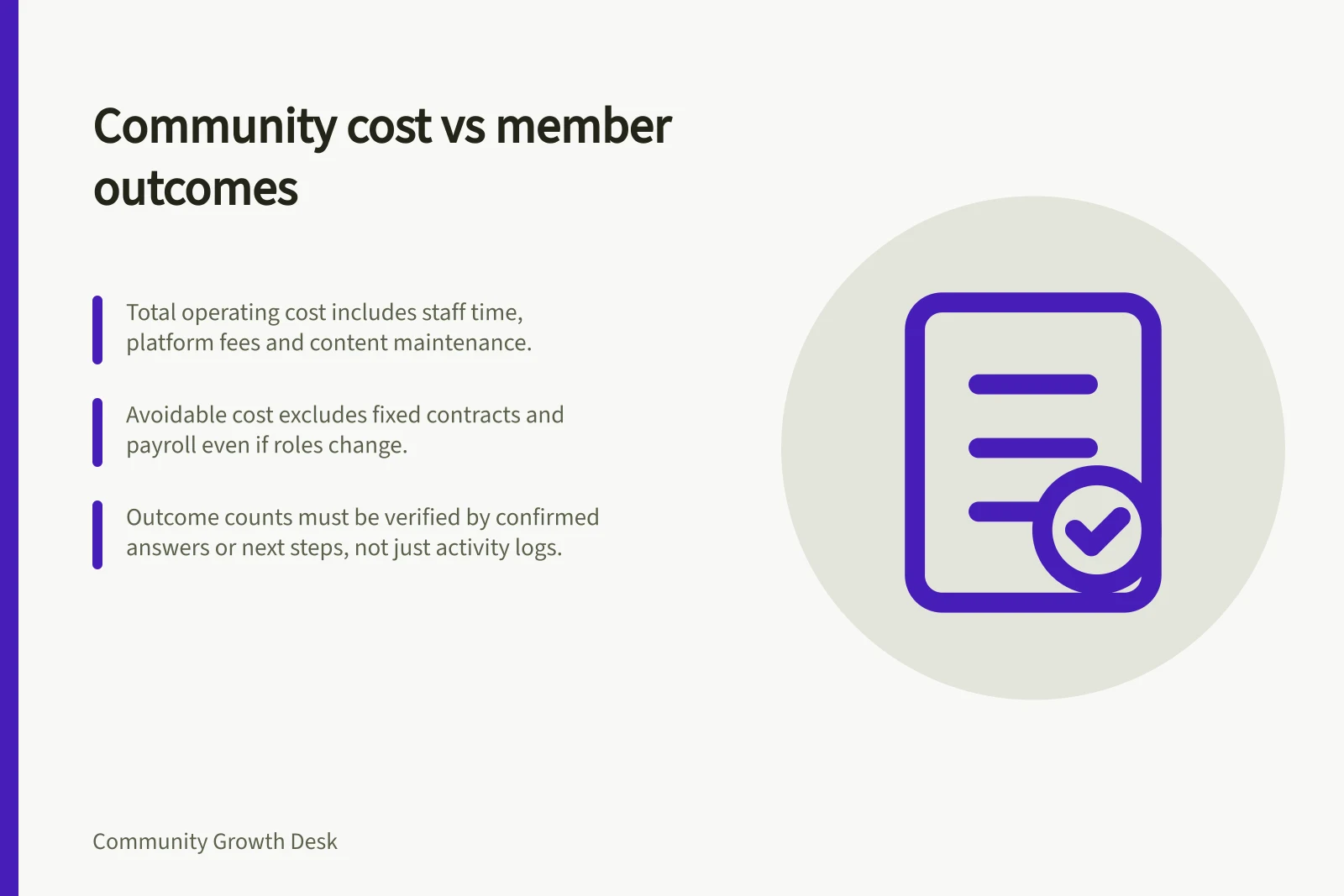
Separate total cost from avoidable cost. Total cost describes the resources consumed, while avoidable cost asks what spending would actually stop if the community changed or closed. Reassigning a staff member may free capacity without reducing payroll; a prepaid contract may remain payable after closure.
Key Community Cost and Outcome Indicators
- Total cost (operating)
- To be calculated from platform, staff, content, events, admin
- Avoidable cost
- Spending that would stop if community changed or closed
- Ongoing vs one-off costs
- Categorised by recurrence (e.g., monthly subscriptions, event fees)
Use outcomes tied to the member promise
Choose outcomes before looking for a favourable ratio. A help community might record confirmed useful answers, clear private handoffs and questions still open. A peer group might record a member’s confirmed next step after an exchange. Count eligible people or needs under stated rules and keep unknown outcomes separate from success.
A platform activity report can locate material for review, but it cannot by itself establish member benefit. Zendesk, for example, documents community activity, support tickets and user sessions in separate reporting datasets. The team must still determine how records relate and whether a claimed outcome is supported. Give included questions comparable time to receive and confirm help.
Calculation to consider
- Cost per documented useful outcome
- Full period cost divided by outcomes meeting the agreed rule
- Cost per support case handled in the community
- Relevant operating cost divided by eligible handled cases
- Cost of a proposed change
- Additional or avoidable cost for each option
What to disclose
- Cost per documented useful outcome
- Outcome definition, count, overlapping outcomes and unobserved readers
- Cost per support case handled in the community
- Staff time, unresolved cases and work transferred elsewhere
- Cost of a proposed change
- Contract commitments, transition work and effects on members
A cost per outcome describes spending against a defined count; it does not prove the community caused the outcome. The ratio may fall if difficult cases are excluded or necessary moderation is cut. Read the cases behind any movement.
Cost per Outcome Metrics for Community Performance
- Cost per documented useful outcomeFull period cost ÷ outcomes meeting agreed rule
- Cost per support case handled in the communityRelevant operating cost ÷ eligible handled cases
- Cost of a proposed changeAdditional or avoidable cost for each option
Steps to Evaluate Community Value in Australia
- Define clear member outcomese.g., confirmed useful answers, next steps taken, resolved needs
- Apply consistent rules to count outcomesExclude unknowns; track overlapping or unobserved readers
- Separate platform data from member benefit assessmentZendesk reports activity separately—verify claims manually
- Calculate cost per outcome with transparencyDisclose definitions, counts, and limitations
Value only what can be defended
For a monetary estimate, describe the mechanism first. If an answer replaces a support contact, use cases with credible evidence that the need was resolved and would otherwise probably have required support. Account for community work needed to produce and maintain the answer.
If retention is involved, use the organisation’s own customer economics and a comparison strong enough to support the claimed influence. Leave uncertain or qualitative benefits visible without assigning them an invented price.
Present two views: observed member outcomes against total operating cost, and the incremental costs and expected member effects of the next option. State what remains unknown and what evidence the next review should collect.
Pros and Cons of Using Community Metrics for Decision-Making
- ProsSupports evidence-based decisions; clarifies cost-benefit trade-offs; aligns with ATO and business reporting standards
- ConsMay misrepresent impact if outcomes are cherry-picked; does not prove causation; risk of overestimating savings without strong evidence