Health Measures
Part of Measuring community health
Active contributors versus registered members
Define active contributors and an eligible member denominator, then read what the figures reveal about participation and workload.
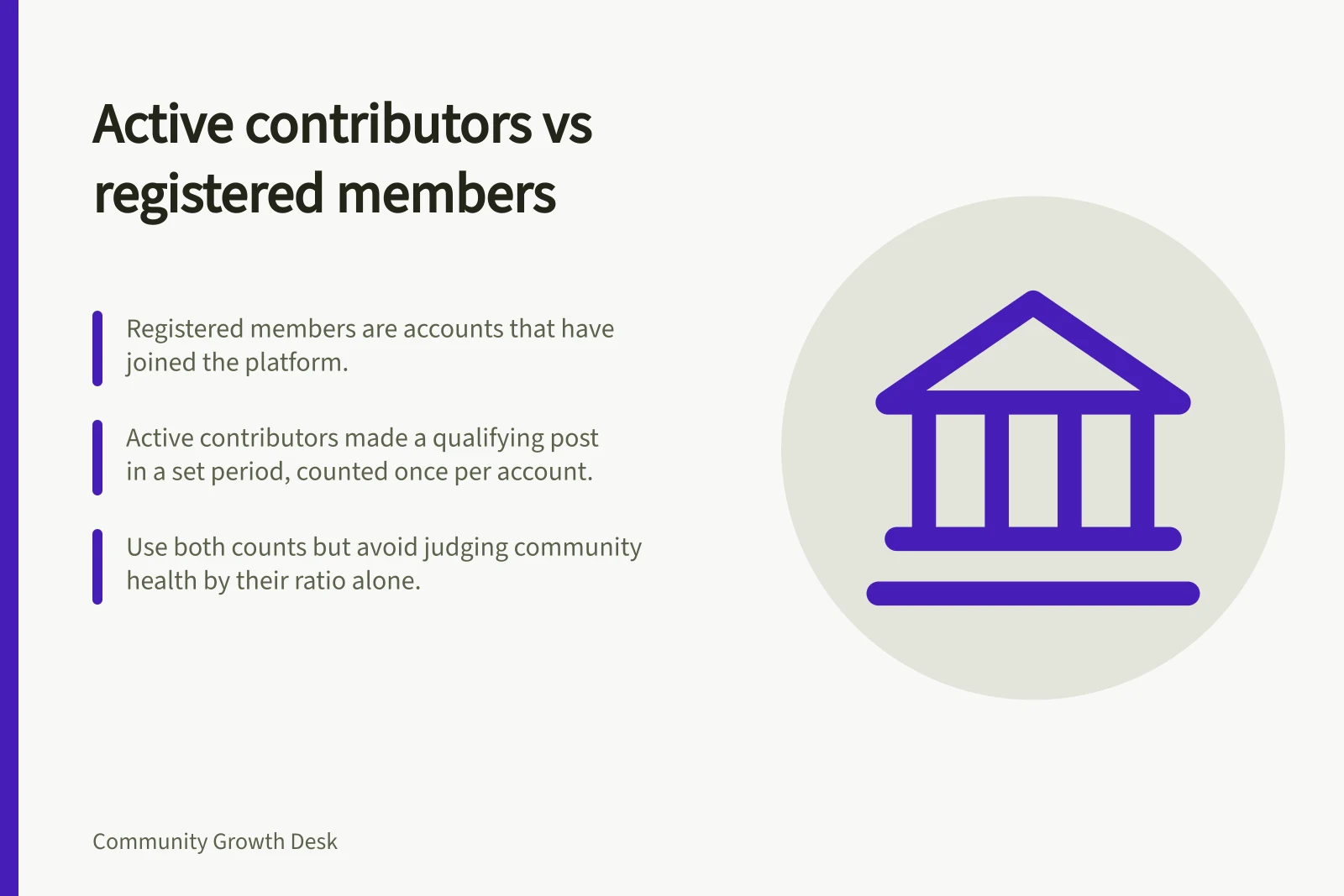
Registered members are accounts that have joined. Active contributors are eligible member accounts that added a qualifying contribution during a stated period. Use both counts, but do not treat their ratio as a verdict on community health. Some members get value by reading; others have no current reason or ability to participate.
Define both counts before calculating
For registrations, decide whether the count includes pending, disabled, staff and test accounts. For contributors, choose qualifying actions and a period.
A practical starting rule is an eligible member account that posts a relevant question, reply or substantive addition during the period. Count each account once, however many times it posts. If one person can hold multiple accounts, say that the result counts accounts unless they can be reliably deduplicated.
Platform labels may mean something else. Discourse admin dashboard reports include activity from real users, including staff activity, and exclude the system user. Check a report's definition before treating its figures as member contributions.
GitHub Discussions daily contributor insights include reactions and upvotes as well as comments and posts. Neither figure can simply be renamed to measure members who added substantive knowledge.
Set a rule for borderline actions. Does a reaction count? Does a welcome-thread introduction count? What about a moderator's answer, an automated post or an edit to an old resource?
Choose actions that match the exchange you want to understand. Keep the rule stable for comparisons and disclose changes.
Active Contributors vs Registered Members: Key Definitions and Metrics
- Registered MembersAccounts that have joined the community; includes pending, disabled, staff and test accounts unless excluded by rule.
- Active ContributorsEligible member accounts that made a qualifying contribution (e.g., question, reply, substantive addition) during a defined period. Counted once per account regardless of frequency.
Considerations When Defining Qualifying Actions
- ProsClarifies what counts as meaningful participation; supports consistent tracking over time.
- ConsRisk of misrepresenting engagement if borderline actions (e.g., reactions, welcome posts) are included without clear rules.
Choose an eligible denominator
A lifetime registration total accumulates while the set of people able to contribute changes. If you calculate a contributor share, define the denominator and ensure contributors are included in it.
One option is qualifying contributors during a month divided by member accounts that could contribute at some point in that month. Report both counts and note if many accounts had access for only part of the period.
That denominator still misses some people who may benefit. A public forum can serve readers without accounts. A customer-only space may include customers who solved a problem months ago and have no reason to post now. Report observable reading separately where appropriate; do not assume that silent accounts are dissatisfied.
For a hypothetical illustration, suppose 24 of 160 eligible accounts made a qualifying contribution in one month. The share under that rule is 15%. It says nothing by itself about whether the other 136 found an answer, needed to visit or could find a suitable way to participate. The figures are an arithmetic example, not an observed result or target.
Check who carries the conversation
Count distinct question askers and answerers, then examine whether staff or a small group of members supplies most replies. A community can have many contributors yet leave newcomers' questions to one overworked person. A few careful answers can also serve many readers.
Read a sample before calling contributions useful. Separate answers that advance a member's task from greetings, repeated promotions and short acknowledgements. Include unanswered questions. If the contributor count rises after a compulsory introduction prompt, the change may describe the prompt rather than better help.
Use the result to choose an action. Arrange coverage if relevant questions go unanswered. If potential answerers cannot find questions suited to their experience, improve how those questions surface. If many members appear to read without posting, a voluntary, specific question about what they found useful may reveal more than a campaign to raise the posting rate.