Onboarding
Part of Community onboarding and member activation
Designing a welcome flow without overwhelming newcomers
Build a concise community welcome that gives new members a relevant next step and leaves optional setup for later.
Give a newcomer one clear next action, then offer more help when needed. Open with the community’s purpose and a choice that matches why they joined. Leave optional setup, notifications and background reading available, but not as hurdles before a useful conversation.
Decide what belongs on the first screen
Separate essential information from what can wait. A person may need to know who can see their posts, where to raise a question and how to get private help. They rarely need a tour of every category before reading one relevant discussion.
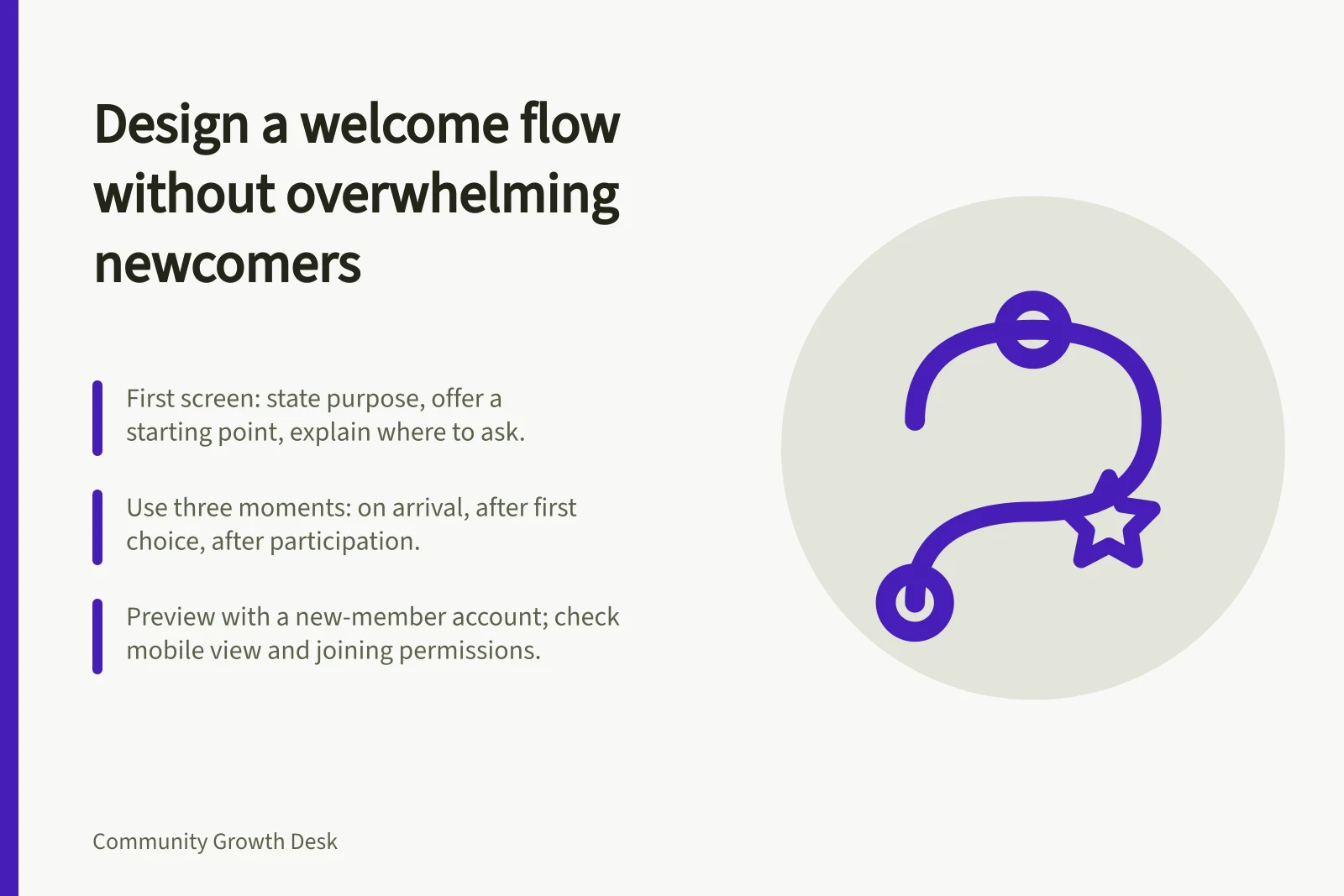
Use the first welcome message to state the purpose in a sentence, offer a practical starting point and explain where to ask if that path does not fit. Keep conduct expectations nearby in plain language.
If a customisation question determines which channels or topics a member sees, explain the effect of each choice. Ask it before entry only when that timing is necessary.
A hypothetical welcome for a group of small service businesses might say: “Trying to solve a staff-training problem? Read the current discussion or ask your own question. Here are the participation rules and the private help route.” It gives a next step without assigning an introduction task.
What belongs on the first screen versus what can wait
- Keep on the first screenPurpose in a sentence; who can see their posts; where to raise a question; how to get private help; conduct expectations in plain language; a practical starting point.
- Leave for laterA tour of every category; optional setup; notification choices that do not determine what they see; background reading.
Reveal choices when they become useful
A simple sequence has three moments:
- On arrival:show the purpose, a starting route and essential expectations.
- After the first choice:show a relevant discussion or a clear place to ask.
- After participation:explain how to follow replies, change preferences or explore other areas.
These are moments in the member’s journey, not software steps everyone must complete. Someone may find what they need by reading and never reach the third.
Make optional steps skippable where the platform allows, and avoid repeating the same instruction in a banner, message and email.
Platform controls differ. Check the controls and settings of the space you actually use.
Three moments in a welcome flow
- On arrivalShow the purpose, a starting route and essential expectations.
- After the first choiceShow a relevant discussion or a clear place to ask.
- After participationExplain how to follow replies, change preferences or explore other areas.
Keep the words and timing clear
Write prompts around the member’s task. “What would you like to do here?” is easier to answer than an internal category name. Keep choices distinct.
If two options lead to the same place, combine them. If a required question collects information the team does not use, reconsider why it is required.
Do not promise an immediate human response unless someone is assigned to provide one. Give a welcome thread an owner who will return to replies. Where a member might share account details or sensitive circumstances, show the private route before asking for a public question.
Check the experience from the first screen
Preview the flow with a new-member account or someone unfamiliar with the community. Can they recognise a suitable route, skip optional steps where available and recover from a wrong choice? Check the mobile view and joining permissions. Use the points where they hesitate to revise the wording or sequence.
Checks for the first-screen experience
- Can a newcomer recognise a route that suits them?
- Can they skip optional steps where the platform allows?
- Can they recover from choosing the wrong option?
- Have you checked the mobile view?
- Have you checked joining permissions?
- Have you noted where they hesitate and revised the wording or sequence?