
Onboarding
Part of Designing recurring community discussions
Choosing prompts that invite practical experience
A useful community prompt asks members for an experience they can describe and others can learn from.
A useful community prompt asks members for an experience they can describe and others can learn from. It should be narrow enough to answer without a long essay, open enough for more than one valid answer and clear about the kind of detail wanted.
Begin with a real decision
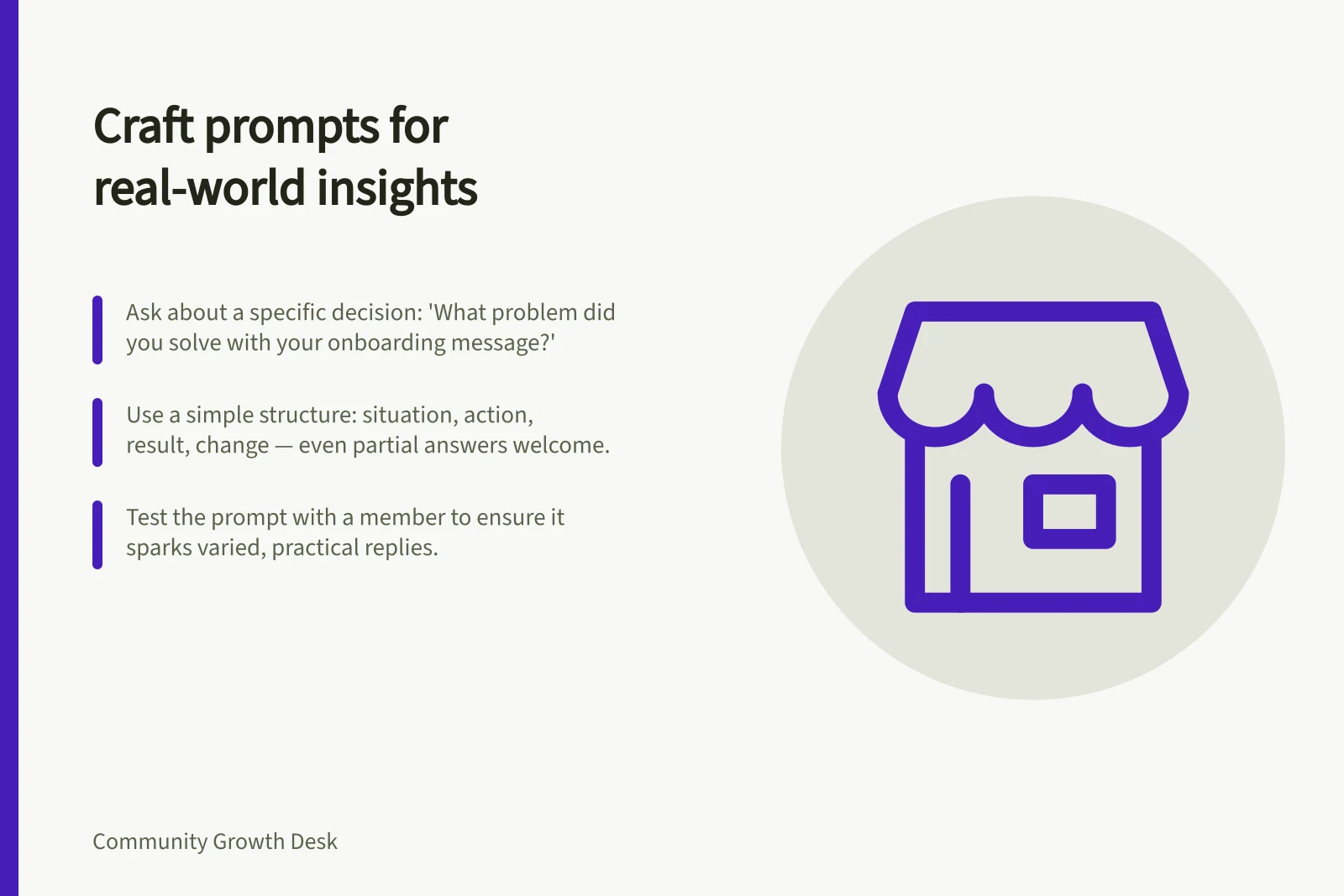
List a decision members face repeatedly. Ask about the circumstances, action and result. One example: “When you changed your first-week onboarding message, what problem were you trying to solve and what did you observe?” That is more answerable than “What is the best onboarding strategy?” The first invites a bounded account; the second pressures people to make broad claims.
Keep the question within the community's subject. A prompt written to generate comments may attract debate without helping members do anything. Use a recent discussion or unanswered question as evidence that the theme matters. Then write a fresh invitation that does not force people to repeat the old thread.
Lower the effort to contribute
Offer a short structure: situation, what you tried, what happened and what you would change. Tell members that partial answers and unresolved problems are welcome. If sharing precise metrics or customer details is sensitive, invite ranges or qualitative observations instead. Do not ask people to expose private information to make the thread appear concrete.
Give one example reply from the moderator's own experience if available, or a clearly labelled hypothetical example. Avoid a polished “model answer” that makes ordinary members feel their contribution must be equally finished. Ask one main question; a long list of subquestions often means the theme should be split.
Test the prompt before scheduling it
Show the draft to someone familiar with the community. Can they answer in two or three sentences?
Would two members with different circumstances give different useful answers? Is the question leading towards a product endorsement or a preferred conclusion? Revise until the expected variety is clear.
Recurring threads can bring members together around a repeated topic, and welcome threads work better when a moderator replies to participants. The prompt is only the opening move. Plan a follow-up question and an owner who will return to the conversation.
After each edition, inspect the substance of answers. If people mostly reply “same here” or ignore the request, the question may be too broad, too repetitive or poorly timed. Use what members actually say to write the next prompt.
Pre-Posting Prompt Review Checklist
- Can someone answer in 2–3 sentences?Yes
- Do different members provide varied responses?Yes
- Is the prompt leading to a product endorsement or bias?No
- Have you planned a follow-up moderator response?Yes
Key Metrics for Evaluating Prompt Success
- Variety of experiences shared
- Multiple distinct answers expected
- Frequency of 'same here' replies
- Low (indicates engagement beyond agreement)


