Onboarding
Part of Community onboarding and member activation
Helping new members find their first useful discussion
Choose and present relevant community discussions so a newcomer can find an answer, join an exchange or ask a better question.
Start with what a newcomer came to do, then show them one or two matching discussions. A busy or recent thread is not necessarily useful. The right first discussion gives them an answer they can assess, an exchange they can join or enough context to ask a better question.
Sort by task, not popularity
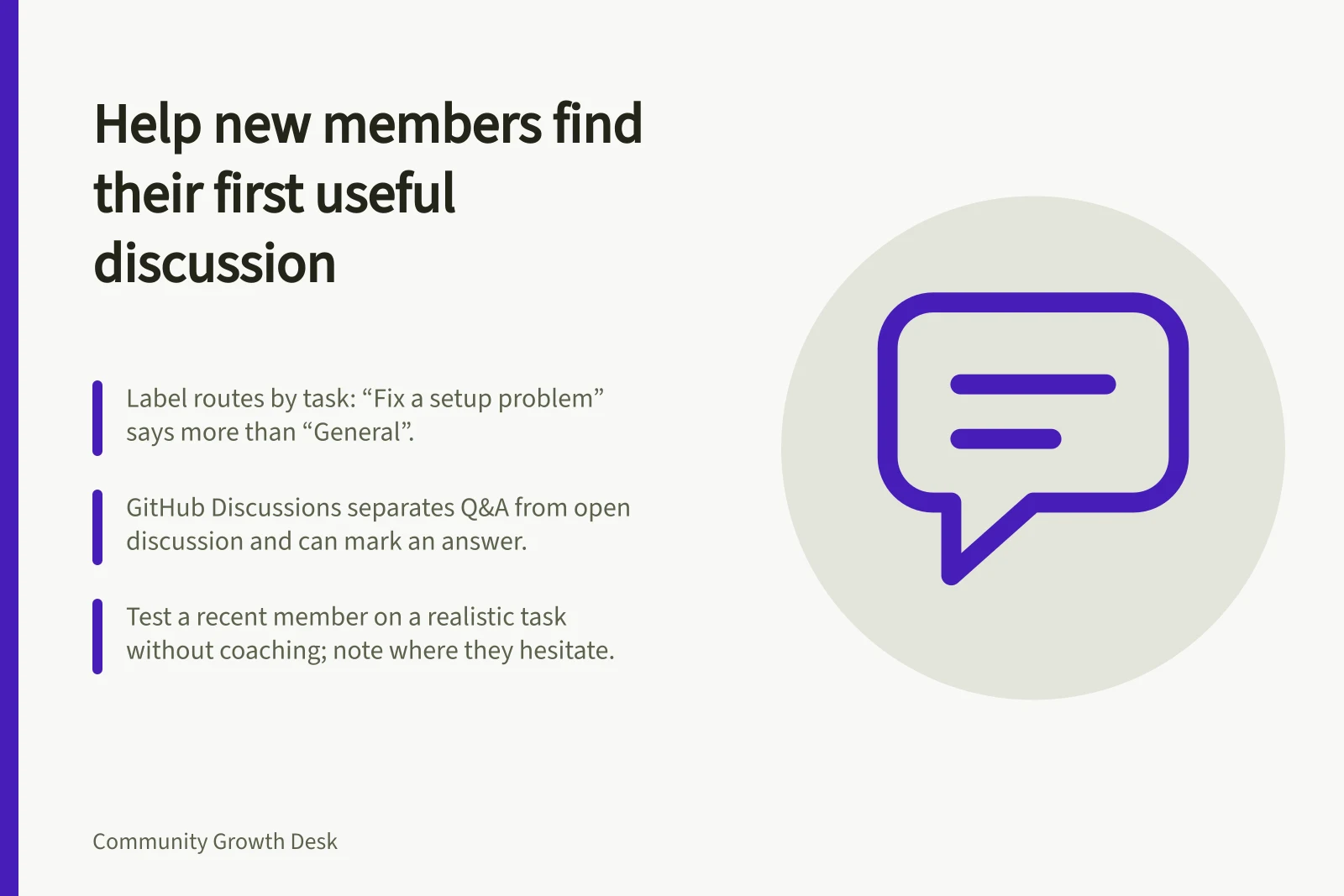
Ask whether the person wants an answer, a comparison of experiences or a place to raise an unresolved problem. Label each route by the task. “Fix a setup problem” says more than “General”; “Compare approaches to staff training” says more than “Chat”.
Inspect a discussion before recommending it: does the opening explain the situation, can a newcomer understand the replies without private context, is the advice still current, and is someone available for follow-up? Reactions and recency do not answer those questions.
Platform tools can narrow the search. GitHub Discussions separates question-and-answer categories from open-ended discussion and can highlight a marked answer.
These controls help locate candidates; a host still has to assess relevance and limits. A marked answer describes what settled one question, not what will work for everyone.
Before recommending a discussion
- The opening explains the situation
- A newcomer can understand the replies without private context
- The advice is still current
- Someone is available for follow-up
Task-based routes versus popularity or recency
- Sort by taskLabel each route by what the newcomer wants: an answer, a comparison of experiences, or a place to raise an unresolved problem.
- Sort by popularity or recencyA busy or recent thread may not answer the newcomer’s question or be current.
Offer a small, clear route
A welcome message might offer two paths: “Looking for an answer? Start with these current questions” and “Want to compare approaches? Join this discussion.” Explain why each destination is worth opening. Group several possibilities under a task instead of presenting an unexplained list.
Check that a newcomer can open the suggested thread, understand its rules and tell whether a reply is welcome. If the conversation is closed or its answer covers only one case, show where to ask about a different case. Provide a private help route for account details and other information that does not belong in a public reply.
Search helps when someone knows how to describe their question. On a Discourse site, an enabled welcome banner can place a search field on topic lists. Test suggested searches using newcomers’ wording and inspect whether the results lead to current, relevant discussions.
Checks for a welcome route
- Offer two pathslooking for an answer, and wanting to compare approaches
- Explain why each destination is worth opening
- Group possibilities under a task instead of presenting an unexplained list
- Check the newcomer can open the thread, understand its rules and tell whether a reply is welcome
- If the conversation is closed or covers one case, show where to ask about a different case
- Provide a private help route for account details and other non-public information
Follow the first click
Ask a recent member to find help for a realistic task without coaching. Note the label they choose, the discussion they open and where they hesitate. If they cannot tell whether an answer applies, improve the title or context. If the right discussion is buried, improve the route into it.
Watch what happens when a newcomer joins a thread. If they ask a question, arrange a useful reply or a clear next step. If they read without posting, an optional follow-up can ask whether they found what they needed. A compulsory first comment is a poor substitute for a useful first encounter.
Follow the first click: test and improve
- Ask a recent member to find help for a realistic task without coaching
- Note the label they choose, the discussion they open and where they hesitate
- If they cannot tell whether an answer applies, improve the title or context
- If the right discussion is buried, improve the route into it
- When a newcomer joins a thread, arrange a useful reply or a clear next step
- If they read without posting, an optional follow-up can ask whether they found what they needed