Moderation
Part of Community content and knowledge libraries
Separating official guidance from member opinion
Label approved guidance, member experience and answers under review so community readers can judge what applies to them.
Show the status of an answer where members read it. Label organisation-approved instructions as official guidance, attribute member accounts, and explain when an answer is awaiting review. A helpful reply, even one selected as a solution, should not silently become company policy.
Define what each label promises
Set a short editorial rule for the community:
| Label | What readers may expect | Who checks it |
|---|---|---|
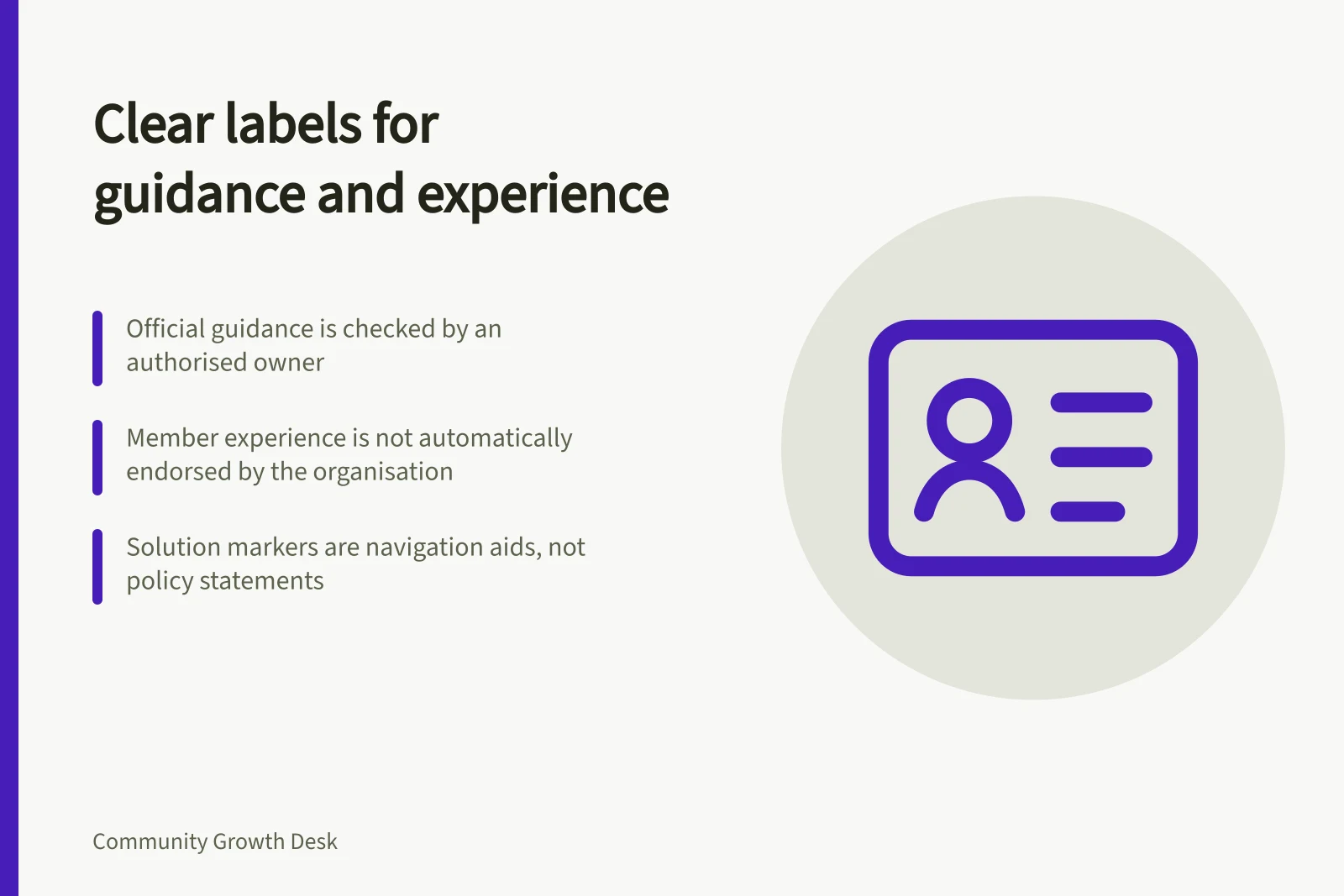
| Official guidance | The organisation's current instruction for the stated situation | An authorised owner |
| Member experience | What a contributor did or observed in their circumstances | The contributor; the organisation has not automatically endorsed it |
| Under review | Previously maintained guidance awaiting a current accuracy check | A named editor or team |
Use the labels consistently in introductions or notices, according to what the platform can display. A staff badge identifies a role; it does not mean every casual staff comment is approved policy. Staff sharing a personal view can say so plainly.
Understanding Community Content Labels
- Official guidanceThe organisation's current instruction for the stated situation
- Member experienceWhat a contributor did or observed in their circumstances – not automatically endorsed by the organisation
- Under reviewPreviously maintained guidance awaiting a current accuracy check
Keep useful experience without overstating it
Member accounts can describe a workaround, a failed attempt or an unusual setup. Keep the circumstances that make an account useful.
“This worked for my account after the update” has a narrower scope than “This is the way to fix it.” Have the responsible team check a suggestion before repeating it as an organisational instruction if it might conflict with a current rule.
Do not change a contributor's meaning when turning a thread into a resource. An editor can summarise an account with attribution and a clear limit, then publish a separately reviewed official answer if needed. When experiences differ, describe the circumstances rather than forcing a single answer.
Best practices for sharing member experiences
- Attribute the contributor and contextUse phrases like 'This worked for my account after the update' to limit scope
- Do not alter original meaningSummarise with clear attribution and limits; avoid rewording to sound official
- Review before promoting as policyHave the responsible team verify suggestions that may conflict with current rules
Treat solution markers as navigation aids
Where a platform lets the questioner or staff select a solution, that marker helps readers find what settled the original question. It does not establish whether the reply applies to every account, product version or later policy. Put a qualification near a narrowly applicable answer, and make a correction visible if the information changes.
For example, where Discourse Solved is available and enabled, topic authors and staff members can mark a reply as the topic's solution. Moderators can also make a Staff Post. These controls have different purposes, and the community still needs to say who approved an instruction and when it should be reconsidered.
Readers should be able to distinguish an approved instruction from a personal account without inspecting profiles or guessing from tone.
Using solution markers effectively
- Pros
- Helps readers quickly identify what resolved the original issue; useful for navigation
- Cons
- Does not guarantee applicability across all accounts, product versions, or future policies