
Onboarding
Part of Community content and knowledge libraries
Turning repeated questions into a community resource
Decide which recurring member questions deserve a maintained answer, then draft, verify and improve a resource people can use.
Turn a recurring community question into one maintained resource when the same answer could help future members. Keep the question in members' words, verify the answer, and point later discussions to the resource while leaving room for cases it does not cover.
Decide whether the question is repeatable
Collect examples from discussions or support contacts. Compare what people are trying to do, not only the words they use.
“Where is the setting?” and “Why can't I find the setting?” may belong in one guide if the circumstances and remedy match. Similar wording may conceal different permissions, product versions or account types; split the answers when the steps diverge.
Check the current library before creating a page. If a relevant guide exists, find out why it failed to settle the question. It may need a clearer title, a missing prerequisite or a correction. Another page with a slightly different heading can leave members choosing between competing answers.
A good candidate has a repeatable task, an answer someone can verify, and enough context to say who it applies to. A discussion asking for personal judgement may be better kept as member experiences than rewritten as one official answer.
Draft from the question, then check the answer
Put the answer or first action in the opening sentence. Follow it with prerequisites, steps, exceptions and a route for readers whose situation differs. Use members' search language in the title while explaining ambiguous terms in the body. “Change the email used for community notices” makes a clearer promise than “Notification information”.
Separate verified information from a participant's guess. On platforms that let someone select a solution, that selection helps readers find what settled the original discussion; it does not independently verify the advice for every member or later product version.
Ask the responsible product or policy owner to check instructions the organisation will present as official. State any condition close to the step it affects.
Publish with a route back to the conversation
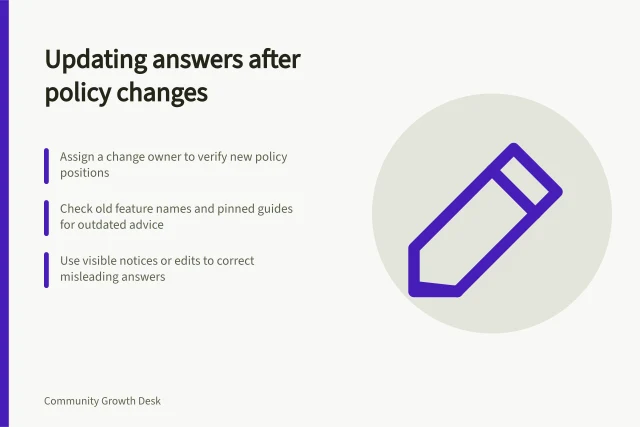
Give the resource an owner and a review trigger, such as a change to the relevant setting. Tell moderators where the maintained answer lives so they can refer to it consistently. In a later thread, address the person's specific question before pointing to the guide; their case may reveal a new exception.
Invite corrections. If the question keeps returning, check whether people can find the page and whether it covers their circumstances. Update its title or content when needed, and record material corrections so readers can understand what changed.