
Onboarding
Part of Designing recurring community discussions
Retiring recurring discussions that no longer help
Retire a recurring discussion when it keeps appearing on the calendar but no longer gives members a useful reason to take part.
Retire a recurring discussion when it keeps appearing on the calendar but no longer gives members a useful reason to take part. First check whether the problem is theme, timing, visibility or moderation. A quiet edition is a signal to investigate, not automatic proof that the series has failed.
Look beyond comment count
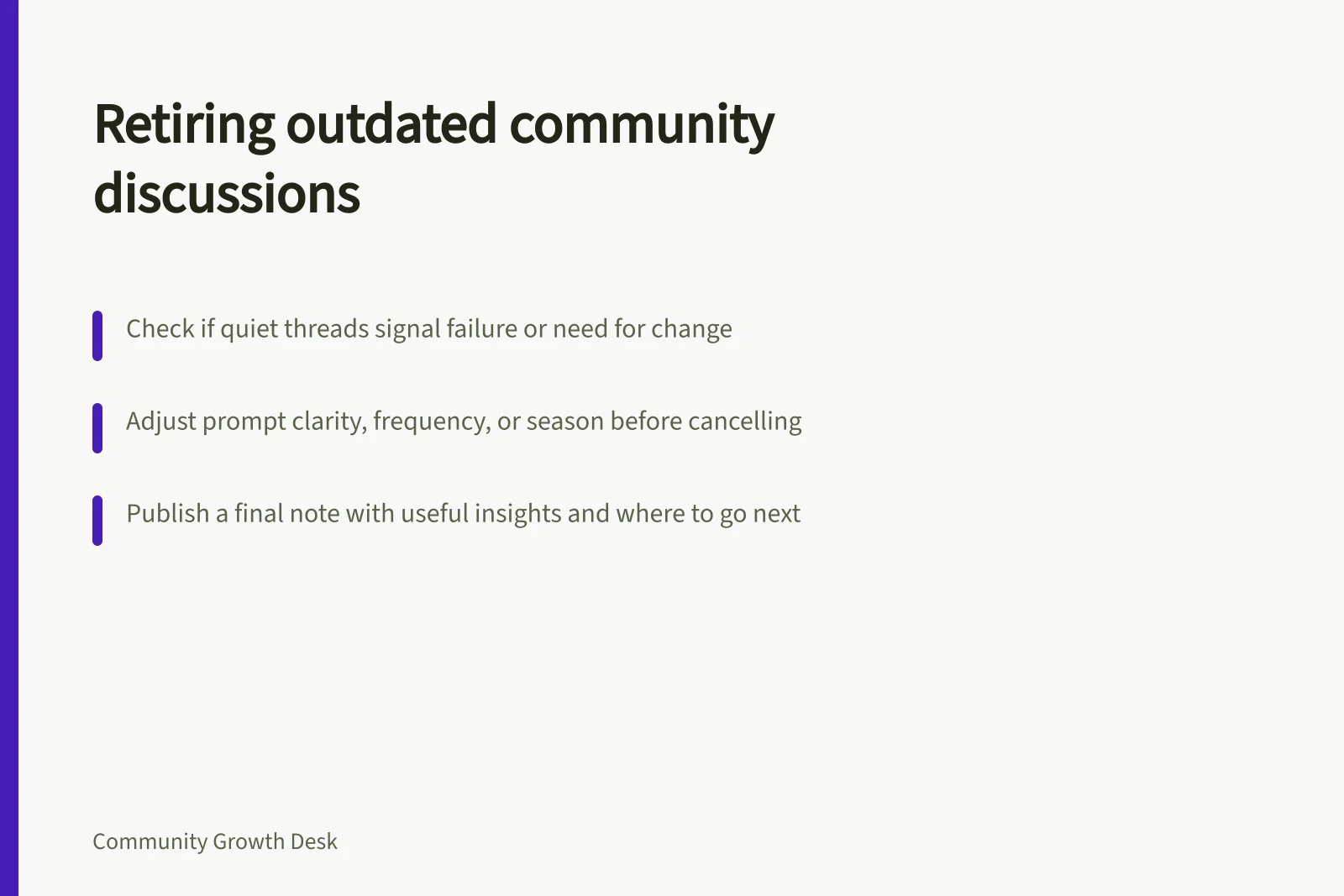
Review several editions. Are questions getting substantive answers? Do new people contribute? Does anyone return to report what happened after taking advice? Is the moderator spending significant time starting every exchange? A short thread with one useful exchange may be healthier than a long run of repeated greetings.
Read the answers. If members keep giving the same response, the prompt may have exhausted the topic. If they ask different questions underneath it, the series may need a narrower theme. If people share sensitive issues that cannot be answered well in public, move that need to a more suitable route instead of asking for more detail in the thread.
Choose a proportionate change
Try a clearer prompt, a lower frequency or a defined season before cancelling a valuable theme. A monthly thread may suit a slow-moving practice better than a weekly one. Explain the change briefly so regular contributors know where to go. Do not keep a series only because a scheduling tool makes it effortless to publish.
If the discussion has genuinely run its course, publish a final note with a short account of what members found useful and where related questions now belong. Stop future scheduled posts, but consider keeping useful past threads accessible under the community's retention rules.
Learn from the experiment
Record the original purpose, the evidence for changing it and what you will try next. A different format, or an evergreen guide, may serve a community need better. Ask members what they would miss before assuming an empty thread has no value.
Closing a recurring discussion is a service decision. It frees attention for questions members are ready to discuss now, while preserving the knowledge the earlier conversation produced.


