
Health Measures
Part of Measuring community health
Measuring whether members receive useful answers
Build a question cohort, distinguish confirmed from indicated answers, and keep unresolved cases visible in community reporting.
Start with the questions members actually asked. Count those that received a response addressing the need or giving a usable next step within a stated time, then inspect unresolved cases. Reply counts or a “solved” marker can locate conversations, but neither alone shows the member could use the answer.
Define the question set
Choose the period in which questions were opened and the kinds in scope. Exclude announcements and general discussion if the measure describes requests for help. Keep duplicate questions visible in the working record, even if the team later combines them into one maintained resource: each person may have had a different need or outcome.
Decide how long a question has to receive help before assessing it. Apply the same window to each question in a cohort and wait until the window closes before reporting results.
A question posted late in a month otherwise has less opportunity to receive an answer than one posted early. Record private support referrals separately when the public community cannot responsibly resolve an issue. Note whether a clear handover happened without claiming to know the private outcome.
Code what the answer did
A working review rule can use four states:
| State | Evidence needed |
|---|---|
| Useful answer confirmed | The asker says the response solved the stated problem or enabled a useful next step. |
| Useful answer indicated | A reviewer identifies a response that addresses the question with relevant conditions, but the asker has not confirmed the outcome. |
| Still open | No substantive answer addresses the stated need within the assessment window. |
| Outcome unknown | The visible exchange or handover does not establish what happened. |
These are proposed coding states, not automatic platform fields. Write examples for reviewers and revisit disagreements.
A clarifying question may be good service, but it is not yet an answer to the member’s problem. A link to a guide counts as useful only when that guide addresses the case and gives the person a way forward if it does not fit.
Discourse Solved lets topic authors and staff mark a reply as a solution where the feature is available and enabled; Discourse says it is unavailable on the Free plan. GitHub Discussions can highlight a marked answer in a category that accepts answers.
These controls make a reply easier to find. They do not verify that it fits the asker’s circumstances or remains current.
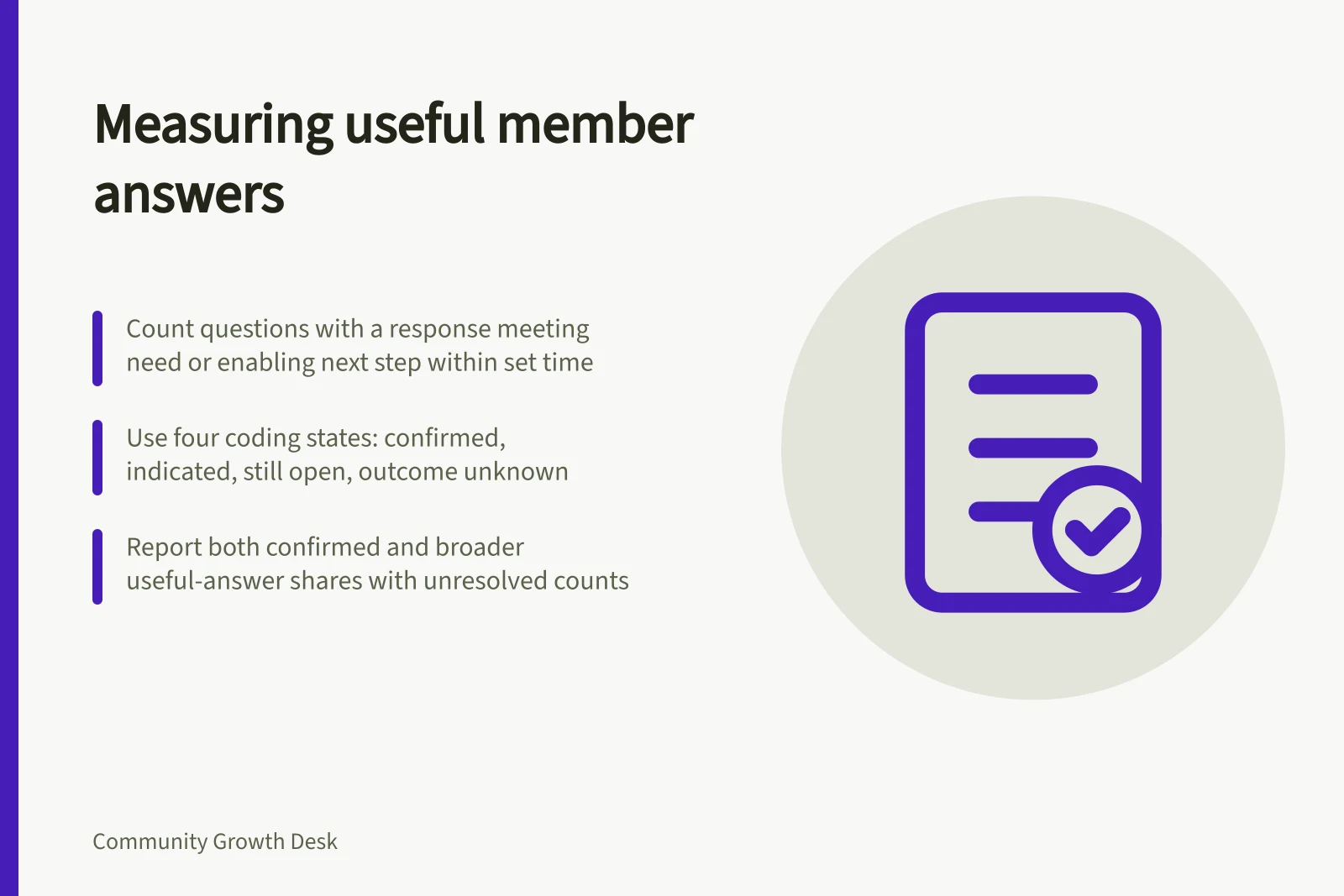
How to Measure Useful Answers in a Community
- Define the question setChoose time window and exclude non-help requests.
- Code answers using four statesUseful (confirmed), Useful (indicated), Still open, Outcome unknown.
- Report counts for each state and clarify if useful rate includes only confirmed or also indicated answers.
- Inspect time to first response and time to substantive answer separately.
- Use findings to improve help—create maintained resources or refine private support paths.
Pros and Cons of Using 'Solved' Markers on Platforms
- ProsMakes solutions easier to find; helps members quickly identify resolved issues. Available in Discourse (if not on Free plan) and GitHub Discussions.
- ConsDoes not verify fit to asker’s context or long-term validity; may encourage premature closure without confirming actual usefulness.
Report the outcome and the gap
Show the number of eligible questions and the count in each state. If you report a useful-answer share, say whether it includes only confirmed answers or also reviewer-indicated ones. Keep those two counts visible, along with the number still open or unknown.
Inspect time to first response and time to a substantive answer separately. A quick acknowledgement can reduce uncertainty, but it should not stop the clock for useful help if an answer comes later. Discourse's admin dashboard includes a report showing a daily tally of posts marked as solutions. That is a narrower measure than this question-level review.
For a hypothetical review, ten eligible questions might include four confirmed useful answers, two reviewer-indicated answers, three still open and one unknown. Under a confirmed-only rule, the result is four of ten; under a broader rule, six of ten. Neither figure should appear without its definition and the unresolved count.
Use the review to improve help
Group open questions by cause. Were they hard to find, missing context, outside staff expertise or waiting on an owner? Check whether an apparently complete answer left the member asking the same question again.
Where guidance is stable and the problem recurs, consider a maintained resource. Where it depends on account details, improve the private route.
Ask members about usefulness when appropriate without requiring them to mark every thread solved. The measure should help the team find people still waiting for help, not pressure questioners to close a case early.


