Health Measures
Part of Measuring community health
Tracking member return rates without rewarding empty activity
Build a member return cohort, separate repeat visits from useful outcomes, and avoid prompts that inflate activity without helping people.
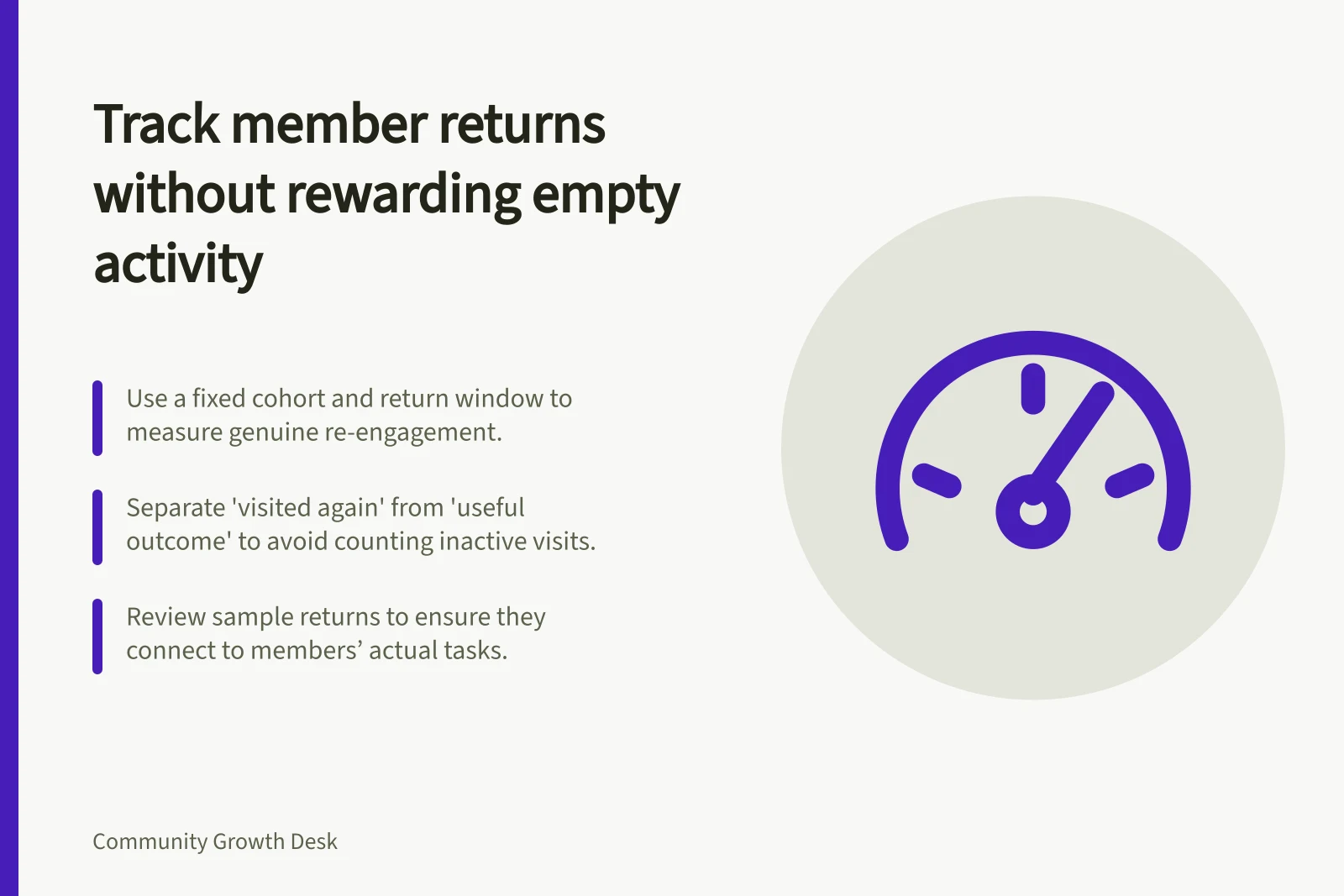
Track return by following the same eligible members into a later period and recording whether they came back for a relevant task. Keep simple visits as a separate measure. A repeat login, reaction or compulsory check-in may show contact with the space, but not that it helped anyone.
Choose the cohort and return window
Pick a clear starting event, such as first access or a qualifying visit. List the eligible member accounts in that cohort once, then set the later period to inspect and its start and end.
Divide the number meeting the return rule by the original eligible cohort count, and show both counts. If people can hold multiple accounts, state whether the measure is account-level or whether identities can be reliably reconciled.
The window should suit the community’s rhythm. Someone who asks an occasional product question may have no reason to return the following week. A group supporting a recurring professional task may expect a different pattern.
Do not change the interval to obtain a more favourable figure; label a changed definition as a new series.
For a hypothetical example, if 40 eligible accounts first gained access in one month and 12 completed the defined return action in a later month, the rate under that rule is 12 of 40, or 30%. This illustrates the calculation; it is neither a target nor an observed community result.
Separate contact from useful return
Use distinct stages rather than one “active” label:
- Visited again:the member account reached the space in the later period.
- Reached a relevant place:it opened content related to a task, where that can be observed reliably.
- Useful outcome observed or indicated:the member confirmed help, or a reviewed exchange met a stated usefulness rule.
Each stage needs different evidence. A page view does not show that an answer was read or applied, and a post does not show that anyone found it useful. Some members gain value by reading without leaving evidence of the outcome; report that limit rather than classifying them as failures.
A community with signed-in records may be able to build a separate account-level cohort. It should check identity, access and event quality before comparing it with web analytics; the two are not the same measure simply because both are called “return”.
Contact vs. Useful Return: What Each Measure Indicates
- Visited againMember accessed the space in the return window (e.g., login or page view).
- Reached a relevant placeOpened content tied to a task (e.g., viewed a help article or thread).
- Useful outcome observedConfirmed help received or exchange met a usefulness rule (e.g., upvote, reply, task completion).
Avoid rewarding empty behaviour
Do not require a comment merely to count someone as returning. A recurring prompt may invite a useful exchange, but a stream of “checking in” replies can lift activity without answering anyone’s question.
Review a sample of return actions for a connection to members’ tasks. Keep unanswered questions and members who could not find a relevant route in view.
Segment only when it changes a decision. New members, occasional help seekers and regular peer contributors may have different reasons to revisit. Show each group’s size; a small segment can move sharply after one person returns.
A low return rate for one-off help seekers does not prove they received poor help. Ask an appropriate sample whether their original need was met and whether they expected to come back.
Best Practices to Avoid Rewarding Empty Behaviour
- Do not count comments alone as returnsAvoid inflating activity with ‘checking in’ replies that add no value.
- Review sample return actionsCheck if returns connect to real member tasks or questions.
- Segment by member typeTrack new members, occasional seekers, and regular contributors separately.
- Survey for feedbackAsk one-off users whether their need was met and if they expected to return.
Act on the gap
If members revisit but cannot find current guidance, improve the route to answers. If they join discussions but receive no follow-up, assign an owner. If they return mainly for host prompts that produce little substance, redesign those prompts and observe what members do next.
Record the definition and any changes beside the trend. The member’s task and observed outcome give a return rate its meaning.
Key Metrics for Evaluating Member Returns
- Cohort size
- 40 eligible accounts (example from article)
- Useful outcomes
- Not specified – must be tracked separately