
Events and Peer Learning
Sharing research questions without disrupting ordinary discussion
Place voluntary research invitations thoughtfully, ask neutral questions and keep ordinary community help threads useful.
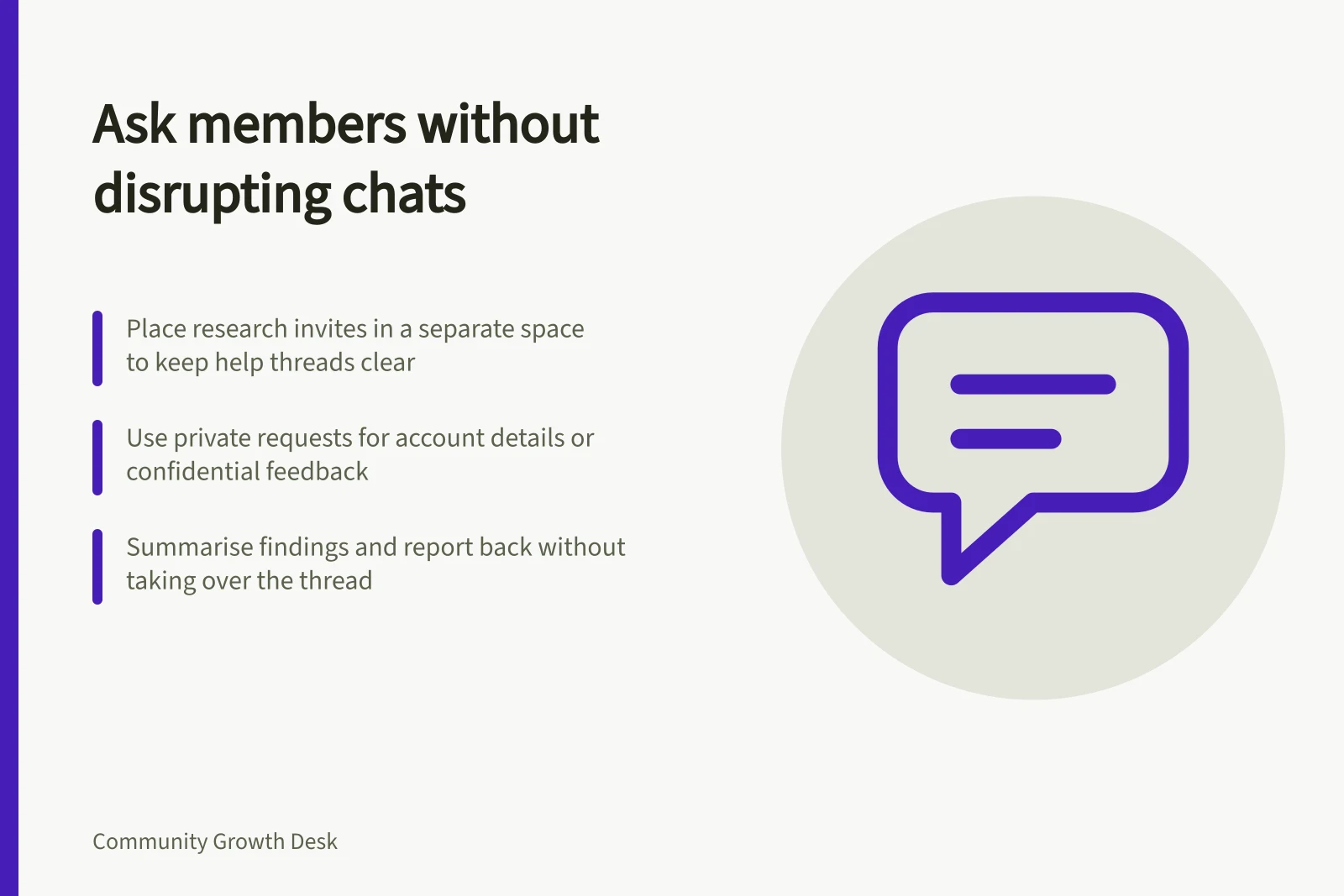
Put the research invitation where members can choose to engage with it. Explain the decision it will inform, keep ordinary help discussions available for their original purpose and move detailed follow-up to a separate, agreed research setting.
Decide whether to ask in the community
Start with the team's uncertainty. Review existing discussions, support contacts and earlier research before asking members to repeat themselves. If the team needs to observe a task or examine account-specific details, offer a voluntary private research route rather than requesting them in a public thread.
Use a community post when members can answer from relevant experience and the discussion may help others. Use a separate invitation when the team needs a defined set of participants, confidentiality or a longer session. An open discussion can reveal explanations; it does not measure what all customers think.
Give the invitation its own space
State who is asking, the topic, why it matters, the time involved, when the invitation closes and what members can expect afterwards. Explain whether replies are public, whether staff may contact volunteers and how to reach the organiser.
If personal information will be collected, check the notice and handling requirements that apply to the organisation. Community membership alone does not establish agreement to every later research use.
Do not place a survey request beneath an unresolved help question. Answer or route that question first. If the person's experience may inform research, invite them separately and make participation optional. Coordinate invitations across teams so members are not repeatedly asked similar questions without hearing what earlier input achieved.
Key considerations for ethical research engagement
- Community membership ≠ consent
- Explicit agreement required for research use
- Consent must be informed
- Participants should know purpose, use, and risks
- Voluntary participation
- No obligation to respond; no penalty for declining
- Privacy compliance
- Follow Australian Privacy Principles (APPs) for personal information
Ask without steering the answer
Prefer a recent task to an abstract preference. “Tell us about the last time you tried to find an earlier answer” invites an account of behaviour. “Would you prefer our improved search?” assumes the proposed design is better. Learn about the problem before testing a proposed solution.
Keep a public post short and ask one clear question at a time. For example: “If you looked for an earlier answer recently, what were you trying to find and where did you look first?” If several questions or a longer conversation are needed, invite members to a clearly explained research activity. Do not request customer identifiers or confidential screenshots in public.
Report back without taking over the discussion
Assign someone to respond to contributions and close an invitation on the stated date. Summarise themes with their limits, explain the next decision and return with an update when there is one. Volunteers' experiences can inform a decision without representing everyone who uses the product.
If members begin helping one another in the thread, preserve that exchange and move only the research logistics elsewhere. The community should remain useful to people who came to participate in ordinary discussion.


